The Feynman Technique: Learn by Explaining Simply

You think you've understood a chapter, until someone asks you to explain it — and you stumble. That's the illusion of mastery trap. The Feynman technique is the antidote: it reveals in minutes what you don't truly understand, by forcing you to explain it simply, without a safety net.
What is the Feynman technique?
The Feynman technique is a learning method that consists of explaining a concept in plain words, as if you were teaching it to someone who knows nothing about it. It draws on the teaching philosophy of Richard Feynman, physicist and Nobel laureate, renowned for his ability to make even the most complex subjects luminous. Its founding principle: if you can't explain it simply, you haven't truly understood it yet.
This is not a note-taking method or a card system. It's a real-time comprehension test. Where re-reading a lecture gives you an impression of mastery, explaining out loud or in writing immediately reveals the blurry zones — those places where you use a technical term without being able to define it, or where you link two sentences without grasping the logical connection.
How do you apply the Feynman technique in 4 steps?
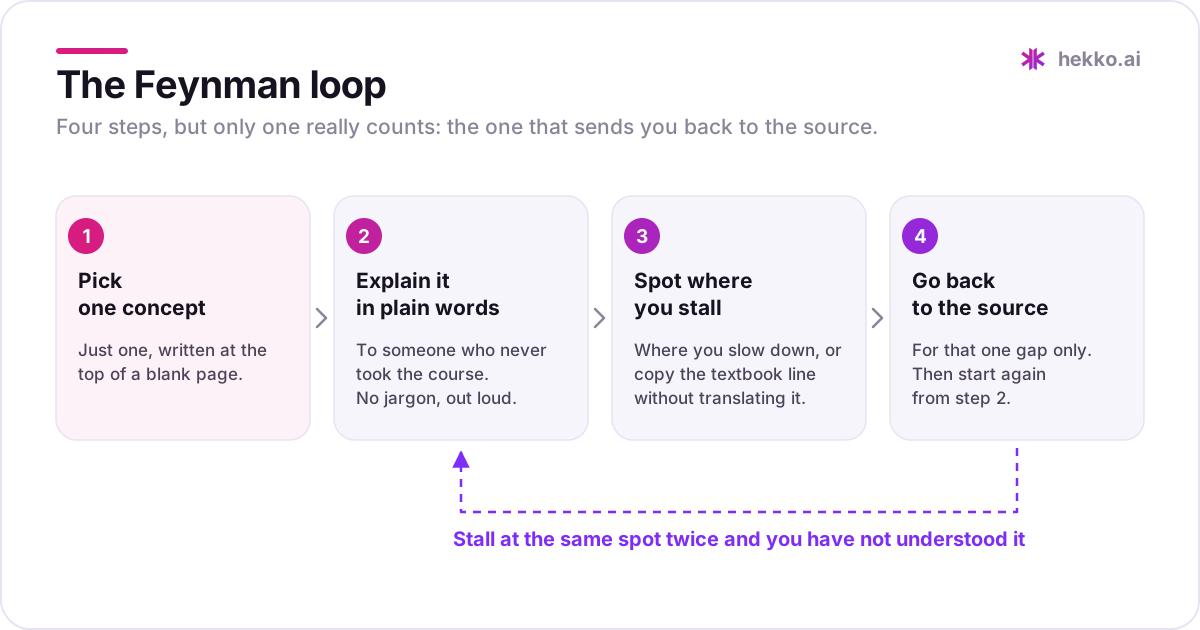
Choose a concept, explain it in your own words, identify your blockages, then go back to your notes and start again. This short cycle — often 20 to 40 minutes per concept — transforms a "I think I know this" into "I know exactly where it breaks down."
Here are the 4 steps:
| Step | Action | What you produce |
|---|---|---|
| 1. Choose | Write the name of the concept at the top of a blank sheet | A clear target |
| 2. Explain | Write the explanation in your own words, without reopening your notes | A first raw draft |
| 3. Identify | Pinpoint every spot where you get stuck, repeat jargon, or go blank | A list of precise gaps |
| 4. Simplify | Go back to your notes on those specific points, then rewrite more simply | A solid explanation |
The genius of the method is in step 3: the blockages you identify are exactly what you need to work on. No need to re-read the whole chapter — you already know where the gap is.
Can you see the Feynman technique in action with an example?
Yes. Take the concept of inflation in economics. Here's how the method reveals the difference between rote jargon and real understanding.
Poor explanation (jargon learned by heart):
"Inflation is the rise in the general price level measured by the consumer price index, resulting from excess aggregate demand over aggregate supply or a negative supply shock."
You may have copied that word for word. But if someone asks you why prices go up, or what it actually means for you concretely, you go blank.
Feynman explanation (your words, zero jargon):
"Imagine there are only 10 pizzas for sale today, but suddenly everyone has more money in their pocket. Every pizzeria can raise its prices without losing customers — people can afford to pay more. That's inflation: prices go up because too much money is chasing too few things."
The second version proves understanding. You can now connect this mechanism to monetary policy, interest rates, or any exam question — because you understood the why, not just the definition.
Why does explaining actually help you memorize?
Explaining forces your brain to reorganize the information, fill gaps in reasoning, and actively produce content — a far deeper cognitive effort than passive re-reading. Nestojko et al. (2014) showed that students who expected to have to teach a text retained it better and organized it more effectively than those who were simply studying for a personal test.
This is the same engine as active recall: producing information from memory anchors it far better than receiving it. Roediger & Karpicke (2006) measured up to ~50% more retention after a week in students who tested themselves rather than re-read. The Feynman technique activates that same retrieval mechanism, but adds a layer of rephrasing that forces deep conceptual understanding.
In practice, your brain has to build connections between ideas to produce a coherent explanation. That's exactly the kind of "elaborative" processing that consolidates memories in the long term.
Does the Feynman technique work for math?
Yes, as long as you adapt step 2 slightly. For math, the explanation focuses less on the definition and more on the reasoning behind each algebraic step.
Take the Pythagorean theorem. A poor Feynman application would be to write "a² + b² = c²." A good application would be to explain why this relationship holds: "In a right triangle, if you build a square on each of the three sides, the area of the big square (the one on the hypotenuse) is exactly equal to the sum of the areas of the two smaller squares. It's a geometric property, not a magic formula."
For proofs, apply Feynman step by step: explain what purpose each line of the proof serves, not just what it says. If you can't justify a step, that's where the gap is hiding.
How long does the Feynman technique take?
For a well-defined concept, allow 20 to 40 minutes: 5 to 10 minutes to write your initial explanation, 5 to 10 minutes to identify and annotate your blockages, then 10 to 20 minutes to revisit the precise points and rewrite. If a single concept takes you more than an hour, it's probably too broad — break it into sub-concepts (e.g., "inflation" → "why prices rise," "how the central bank responds," "effects on real wages").
This time is short compared to a 2-hour passive re-reading session that gives you the illusion of knowing everything. The Feynman technique is dense, not long.
Feynman technique or spaced repetition: which to choose?
The two don't oppose each other — they work at different stages of learning. Spaced repetition optimizes when you review to counter forgetting; the Feynman technique verifies whether your understanding is solid before moving to long-term memorization.
The right order: apply Feynman once after the lecture to anchor conceptual understanding, then integrate the concept into a spaced repetition system to consolidate it over several weeks. Using spaced repetition on a concept you haven't properly understood is like photographing a blurry text — you memorize the confusion, not the knowledge.
Can you use the Feynman technique alone, without a partner?
Absolutely. Many people think you need a real interlocutor, but the essential thing is to write your explanation as if you were addressing someone. The blank sheet serves as a mirror. Two very effective solo variations:
- The learning journal: after each lecture or chapter, write a half-page-maximum explanation in your own words, without reopening your notes.
- The spoken dictation: record yourself explaining the concept, then listen back to spot hesitations and gaps — the places where your voice slows down or where you use "basically," "and stuff like that" without specifying.
If you use Hekko, the structured transcript of your lecture becomes your raw material: browse the generated notes, identify the key concepts, and apply the Feynman steps on each one before making your revision sheet.
Feynman technique, Cornell method, or simple re-reading: which to choose when?
Here's an overview for choosing the right approach based on the moment and the goal:
| Method | What it tests | Ideal moment | Effort |
|---|---|---|---|
| Passive re-reading | Superficial familiarity | First encounter with a topic | Low |
| Cornell method | Organization and links between ideas | During and right after class | Medium |
| Feynman technique | Deep understanding, hidden gaps | During revision, before an exam | High |
| Spaced repetition | Long-term memorization | Over several weeks | Medium / regular |
As a general rule: Cornell to capture, Feynman to understand, spaced repetition to memorize. Re-reading alone is never enough as a primary method — it creates the illusion of mastery without building it.
How does Hekko fit into a Feynman session?
Hekko records your lecture, transcribes the audio (which is then deleted — nothing is stored), and generates structured notes, a revision sheet, and an on-demand quiz. This content becomes the ideal starting point for the Feynman technique: you already have an organized version of the lecture, which lets you go directly to step 2 — explaining in your own words — without wasting time re-reading a dense printout.
In practice: browse the Hekko notes to identify the 3 to 5 key concepts of the lecture, close the app, and apply the 4 Feynman steps on a sheet of paper. When you come back to check on the blocking points, the structured notes let you find the precise information in seconds. You can also use the on-demand quiz as a final check — if you answer the questions correctly after applying Feynman, the concept is genuinely solid.
The Feynman technique isn't comfortable. It reveals what you don't know at the very moment you thought you'd understood everything. That's precisely why it works: it replaces the illusion of mastery with verifiable understanding, concept by concept. Pair it with solid global revision strategies and good in-class note-taking, and you shift from suffering through revision to learning that actually lasts.
Ready to save time on your notes?
Hekko transcribes your lectures and generates notes automatically. Try it for free.
Get started for free