Spaced Repetition: The Method for Never Forgetting Anything
You revise a chapter thoroughly, you've got it down by the evening… and two weeks later it's as if you'd never seen it. This isn't a memory defect: it's the normal functioning of your brain. Spaced repetition is precisely the technique designed to counter this structural forgetting — and science gives it one of the strongest evidence bases of any revision method.
What is spaced repetition?
Spaced repetition means reviewing information at increasingly long intervals — the next day, then three days later, then a week, then a month — instead of studying everything in one session. Each review arrives just before you forget, which anchors the information a little deeper with each pass.
This is the opposite of cramming, where you concentrate all the effort into one big session the night before the exam. Cramming might get you through the test, but the information disappears within a few days. Spaced repetition builds lasting memory.
The principle looks simple on the surface, but it rests on a precise cognitive mechanism — the forgetting curve — that's worth understanding in detail before tackling the schedule.
Why does your brain forget so quickly? The Ebbinghaus curve
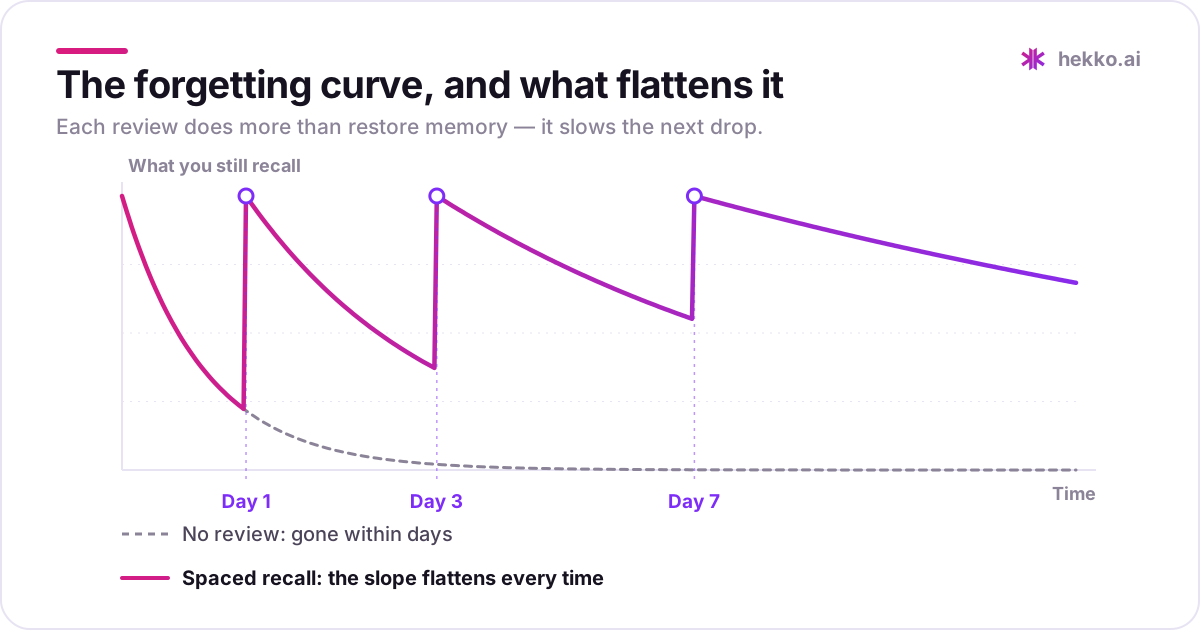
Hermann Ebbinghaus, a German psychologist, was the first to scientifically measure forgetting in 1885. He memorized series of nonsense syllables, then measured how much remained at regular intervals. What he observed became the forgetting curve: immediately after learning, retention is at its maximum; then it drops rapidly during the first hours and days, before stabilizing at a low level.
In practical terms, here's what that means for you: if you attend a lecture on Monday and never look at it again, you'll have forgotten the essentials well before Friday. More precisely, the drop is very steep at the start (the first 24 to 48 hours are critical) and then slows down — which makes the first review the next day particularly valuable.
The good news: every time you revisit the information before forgetting it completely, the curve restarts with a shallower slope. With enough spaced repetitions, memory consolidates and forgetting slows to the point of becoming marginal. That's the "recharge" principle: you intervene at the right moment, not too early (pointless), not too late (you've already forgotten).
Spaced repetition or cramming: which to choose?
Spaced repetition beats cramming in the long run, but cramming is still useful if your exam is tomorrow. For anything that matters beyond 48 hours, spacing wins.
The meta-analysis by Cepeda et al. (2006) synthesized more than 250 studies on the subject. The verdict is unambiguous: for the same total study time, reviewing across multiple spaced sessions almost always beats a single massed session for long-term retention. Put differently, you work just as much — but you retain far longer.
Cramming isn't "bad" in absolute terms: it can help you recall details the night before a midterm. But if you want your knowledge to hold for subsequent exams, for an oral at the end of the semester, or for a professional skill, spacing is essential. You can check our article on revising the night before an exam for how to combine the two intelligently.
What is the ideal interval between two reviews?
There's no universally perfect interval — it depends on your personal forgetting rate, the complexity of the content, and the time remaining before the exam. But a starting schedule widely recognized as robust is: Day+1, Day+3, Day+7, Day+15, Day+30.
Here's a reference table for organizing your reviews:
| Review | When? | Goal |
|---|---|---|
| R0 — Lecture | Day 0 | Take clean, structured notes |
| R1 | Day + 1 | First active recall: test yourself without looking at your notes |
| R2 | Day + 3 | Re-test, focusing on what you missed in R1 |
| R3 | Day + 7 | Short session: quiz or open questions |
| R4 | Day + 15 | Consolidation: test the links between concepts |
| R5 | Day + 30 | Light final review before the exam or a new unit |
Concrete example — exam in 4 weeks:
Say you learn a cell biology chapter on Monday the 1st. Here's what your schedule looks like:
- Tuesday the 2nd (Day+1): 15 minutes — you close your notes and try to answer the key questions from memory.
- Thursday the 4th (Day+3): 10 minutes — you re-test yourself on the points you missed on Tuesday.
- Monday the 8th (Day+7): 10 minutes — a set of questions covering the whole chapter.
- Monday the 22nd (Day+21): 10 minutes — a quick pass before the exam approaches.
- Before the exam: targeted revision on the weak points identified during previous sessions.
Total invested: roughly 50 minutes spread over three weeks, versus a 2–3-hour cramming session the night before — with significantly better retention on the day and in the weeks that follow.
Active recall and spaced repetition: why the two are inseparable?
Spacing passive re-reading is practically useless. What makes spaced repetition effective is spacing the test, not the re-reading.
Roediger & Karpicke (2006) showed that testing yourself on information produces significantly higher retention than re-reading it multiple times — even when you spend less total time testing than re-reading. Dunlosky et al. (2013), in a large review of learning methods, rated spaced practice testing as "high utility" — one of only two techniques to receive this top rating out of all those studied.
In concrete terms: at each interval, close your notes and ask yourself questions. You can:
- Ask yourself out loud "What do I know about this topic?"
- Answer quiz questions
- Summarize a chapter on a blank sheet without looking
- Explain the concept as if you were teaching it (see the Feynman technique)
If you simply re-read your notes at each interval, you create an illusion of mastery — you recognize the information without being able to reproduce it. This is one of the most common traps described in our article on how to revise effectively.
Does spaced repetition work for languages and vocabulary?
Yes — it's one of the areas where it excels most. Vocabulary, conjugations, kanji, lists of technical terms: anything based on form-meaning associations is perfectly suited to spacing.
The advantage of spacing for languages: the brain doesn't just memorize the definition — it also reinforces the automatic retrieval pathway. If you test yourself regularly on a word, you'll eventually stop having to "search" for its translation: it comes on its own. That's the difference between fragile memory (you can recognize the word if shown it) and fluid memory (you produce it spontaneously).
The same logic applies to mathematical formulas, historical dates, chemical reactions, legal definitions — any discrete, testable content.
What tools should you use for spaced repetition?
You don't need a sophisticated tool to get started. Here's an honest comparison of common options:
| Tool | Advantages | Limitations |
|---|---|---|
| Paper calendar | Zero friction, works anywhere | You calculate intervals yourself |
| Paper flashcards | Very effective for vocabulary | Sorting, managing missed cards |
| Anki | Automatic interval calculation (SM-2 algorithm), free | Learning curve, creating cards is time-consuming |
| Hekko | Generates flashcards, the revision sheet and quizzes from your lecture, and schedules every review | Read the generated cards before trusting them |
Anki is the reference software if you want a fully automated interval system. Its algorithm adjusts delays based on your performance on each card. Ideal for foreign language vocabulary or subjects with a high volume of definitions.
Hekko starts from the lecture itself: you record or import your lecture (PDF, images, PPTX, Word), and the app generates structured notes, a revision sheet, quizzes and front/back flashcards. The audio is processed for transcription and then deleted — nothing is stored. The revision mode handles the calendar: every review is placed just before you forget, and Hekko tells you what to go over today. So there are no cards to write and no intervals to calculate — just read the generated cards before trusting them. For the card-by-card method, see our article on revising with flashcards.
For more on creating flashcards, see our article on making revision flashcards.
Looking beyond flashcards? Our comparison of the best AI note-taking apps for students sets out each app's free tier, real price and limits.
How do you integrate spaced repetition into a real revision schedule?
Spaced repetition only delivers on its promises if it's integrated from the start of the semester, not two weeks before the exam.
Here's a simple principle: each new lecture generates a revision sheet the same day (or at the latest the next day) and a first active recall session within 24 hours. Then you schedule the following reviews in your calendar — Day+3, Day+7, Day+15 — just as you'd schedule any appointment.
A few practical rules:
- Keep sessions short: 10 to 20 minutes of spaced active recall is worth more than one long session once a month.
- Note your errors: what you get wrong in a session tells you exactly what to focus on next time.
- Adapt the intervals: if you miss everything in a recall session, shorten the next interval. If you succeed easily, lengthen it.
- Combine with other methods: the Cornell method or the Feynman technique integrate very naturally into a spacing logic — they make it easier to produce testable content.
Spaced repetition isn't a revolution in how you work: it's a calendar adjustment that radically changes the effectiveness of the effort you're already putting in. The brain forgets on a predictable curve — you just need to intervene at the right moment to outwit it.
Ready to save time on your notes?
Hekko transcribes your lectures and generates notes automatically. Try it for free.
Get started for free