How to Revise Effectively: 5 Techniques Proven by Science
You spent six hours re-reading your flashcards and feel like you've retained nothing the next day? That's completely normal — and it's documented. Re-reading is the most widespread study method among students, and one of the least effective. In the landmark review by Dunlosky et al. (2013), it is ranked among techniques with low utility, right alongside highlighting and copying out notes.
This guide walks through the five techniques that actually work, with concrete examples and a comparison table to help you choose the right method at the right moment.
What is the worst revision method?
Passive re-reading is probably the least effective revision technique, despite its popularity. It creates the illusion of mastery — you recognize the words, you skim the paragraphs — without ever forcing your brain to work. Dunlosky et al. (2013) confirm this in a meta-analysis spanning dozens of studies: re-reading and highlighting are rated "low utility" because they don't activate the mechanisms of memory consolidation.
The problem is cognitive: recognizing information is not the same as retrieving it. On exam day, you need to produce, not recognize. If your revision never trains you to produce, you walk into the exam room with a sense of familiarity… but no real memory. The good news: replacing re-reading with any of the techniques below noticeably improves results.
What is active recall and why is it so powerful?
Active recall means closing your notes and retrieving information from memory, rather than re-reading it. It is the best-supported technique in the research: Roediger & Karpicke (2006) showed that students who tested themselves retained around 50% more information after one week than those who simply re-read. Karpicke & Blunt (2011) confirmed that retrieval practice beats even elaborate study strategies like concept mapping.
Why it works: every time your brain has to retrieve information without having it in front of you, it strengthens the neural pathway leading to it. Re-reading doesn't create that effort — it only gives the illusion of doing so.
Concrete example in law: after your lecture on contract law, close your course materials. Take a blank sheet and write from memory: the conditions for a valid contract, the grounds for defective consent, the effects of nullity. Then compare with your notes. The gaps are exactly what you need to work on.
Example in biology: after your lecture on the cell, reproduce the mitosis diagram from memory — prophase, metaphase, anaphase, telophase — without looking at the textbook. Each forgotten element tells you what to reinforce.
How to apply it right now: after each class, spend ten minutes writing down everything you can remember on a blank sheet. Then compare with your notes. This technique pairs perfectly with Hekko: record your lecture, let the AI generate your structured notes, then close everything and quiz yourself with the built-in quiz.
How does spaced repetition work and when should you start revising before an exam?
Spaced repetition means reviewing information at increasing intervals — the next day, a few days later, a week, a month — rather than cramming everything in one go. The meta-analysis by Cepeda et al. (2006), covering more than 250 studies, confirms that spreading revision out significantly improves long-term retention compared to last-minute cramming.
How far in advance should you start? The answer depends on the stakes, but a practical rule: at least three weeks before an important midterm, ideally from the start of the semester for cumulative subjects (math, languages, biology). The longer the gap between sessions, the deeper the consolidation in long-term memory. Cramming the night before may get you through the exam, but you'll forget the essentials within a few days.
Example in history: your midterm on the French Revolution is four weeks away. Week 1: read and take notes. Week 2: short revision (20 min) on key dates and figures. Week 3: quiz yourself on causes and consequences. Week 4: mock exam. This spaced progression anchors information far more durably than an all-nighter.
How to apply it: plan your revision sessions in advance in your calendar. Sessions of 20 to 30 minutes spaced two to three days apart are far more effective than one long session right before the exam. For more on the mechanics of forgetting and optimal intervals, check out our guide on spaced repetition.
What is interleaving and how does it improve results?
Interleaving means alternating between multiple subjects or exercise types within a single session, rather than working on one subject in a block (known as "blocking"). It feels harder in the moment — and that's precisely why it works. Rohrer & Taylor (2007) showed that students who interleaved their math exercises performed significantly better on the final test than those who grouped them by type.
Why it works: alternating subjects forces your brain to actively distinguish between types of problems and retrieve the right strategy each time. Blocking puts you on autopilot: you repeat the same pattern in a loop without really thinking.
Example in math: instead of doing 40 derivative problems in a row, alternate: 10 derivatives, 10 integrals, 10 limits, 10 derivatives. The change of context forces you to identify the right tool for each problem — exactly what you'll need to do on the exam.
Example across multiple subjects: a three-hour session might look like this: 45 min of constitutional law, 45 min of macroeconomics, 45 min of constitutional law, 45 min of macroeconomics. Each return to a subject forces you to recall the context, strengthening memorization.
How to apply it: divide your session into 25- to 35-minute blocks and switch subject or exercise type with each block. Resist the urge to stay on one topic "to finish it" — that resistance is what produces the benefit.
What is elaboration and how do you truly deepen your understanding of a lecture?
Elaboration means asking yourself "why?" and "how?" for each concept, in order to connect it to what you already know, rather than memorizing it as-is. The more explanations and connections you build around a piece of information, the easier it becomes to retrieve on exam day.
A powerful variant: expecting to have to teach the material. Nestojko et al. (2014) showed that students who anticipated explaining a text to someone else retained it better and organized it more effectively than those who were only preparing for a personal test. This method is closely related to the Feynman technique, which consists precisely of explaining a concept in simple terms to identify gaps.
Example in biology: don't just memorize that "photosynthesis produces glucose." Explain why the plant needs light, how water is broken down during the light-dependent stage, what role chlorophyll plays exactly in capturing photons. Each "why" creates an additional link in memory.
Example in economics: faced with the concept of price elasticity, don't recite the formula. Explain why the elasticity of gasoline is low (few immediate substitutes) and why that of business-class plane tickets is high (the business traveler has less choice, but the tourist can wait for a deal).
How to apply it: for each key concept, write an explanation as if you had to give it to someone who has never taken the class. If you get stuck, your understanding has gaps — and that's good news, you've just located them before the exam.
Why do your revision flashcards need to be active?
A flashcard is only useful if it forces you to produce — a question on one side, the answer on the other, and you test yourself before flipping the card. Copying your course out in smaller writing triggers no memory effort at all. A good flashcard forces you to answer from memory, then verify — exactly the principle of active recall applied to paper or digital format.
The angle here is deliberately distinct from a full guide on creating flashcards: for everything related to structure, format, and the step-by-step process, see our dedicated guide on how to make good revision flashcards. What matters in this section is the principle of activation: a passive flashcard (= summary) is worth little; an active flashcard (= interrogation) is worth a lot.
Example in law: front — "What are the three conditions for a valid contract?"; back — "Capacity, consent, lawful object." You test yourself, you answer, you check. If you flip the card before answering, you turn an active flashcard into passive re-reading.
How to apply it: create your flashcards throughout the semester, not the night before the exam, and use them in test mode. The Cornell method applies this mechanism systematically with its cue column — if you take Cornell notes in class, that's already a solid base for generating your active flashcards.
How do you revise when you have little time?
When time is short, the absolute priority is to cut out low-return techniques (re-reading, highlighting) and concentrate every minute on active recall. Thirty minutes of testing yourself on your weak points is worth more than two hours of comfortable re-reading.
The express strategy in three steps:
- Identify the 20% of content that covers 80% of the exam — the key definitions, the essential formulas, the recurring diagrams. Check past papers or ask a classmate who has already taken the exam.
- Do pure active recall: question and answer on each identified point, without ever re-reading before attempting to answer. The gaps you identify are your immediate priorities.
- Use interleaving even in a short session: if you have two subjects to revise in two hours, alternate in 20–25-minute blocks rather than spending an hour on each.
For note-taking beforehand — because good notes are the foundation of effective revision — the article on taking notes in lectures explains how to structure information during class so it's easier to revise later. Hekko can also speed up this step: import your PDF, your Word file, or your PowerPoint presentation, or record your lecture live, and instantly get structured notes, a revision sheet, and a ready-to-use quiz.
Summary: which technique to choose for which situation?
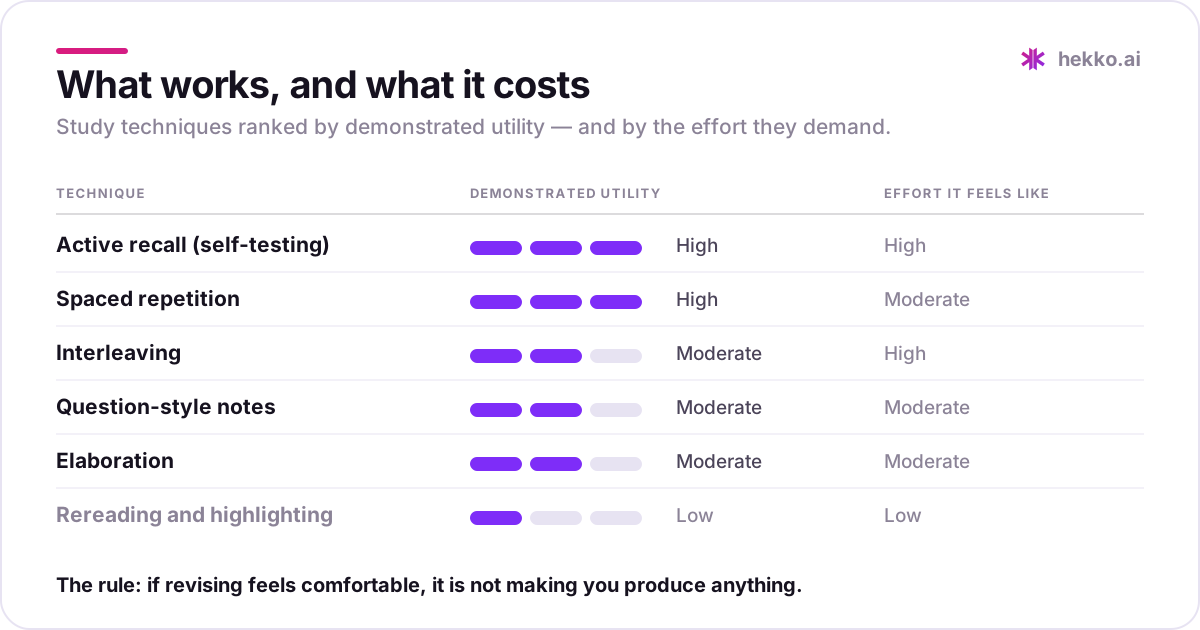
| Technique | Perceived effort | When to use it | Why it works |
|---|---|---|---|
| Active recall | High | After each class, during regular revision | Forces memory retrieval, strengthens neural pathways |
| Spaced repetition | Medium | Over several weeks, planning ahead | Spreads consolidation, counters the forgetting curve |
| Interleaving | High | Multi-subject or multi-type revision sessions | Forces discrimination between problems, avoids autopilot |
| Elaboration | Medium | For understanding (not just memorizing), conceptual subjects | Creates networks of connections that facilitate retrieval |
| Active flashcards | Medium | Throughout the semester, with spaced revision | Combines active recall and spaced repetition in one tool |
| Re-reading / highlighting | Low | Avoid as a primary technique | Creates the illusion of mastery without real memory anchoring |
The winning combination for the long term
The optimal strategy combines these techniques into a routine: structured notes during class → active flashcards created within the week → regular active recall → spaced revision planned in advance → interleaving in sessions. It's more demanding than re-reading — and that's precisely what makes it effective.
If you're starting from scratch or lack a method for structuring your notes before even thinking about revision, start with the article on taking notes in lectures. The quality of your revision depends directly on the quality of your raw material.
Ready to save time on your notes?
Hekko transcribes your lectures and generates notes automatically. Try it for free.
Get started for free