The Cornell Method: The Complete Guide to Effective Lecture Notes
You spend hours re-reading your notes before an exam and feel like nothing is sticking? The problem rarely comes from your memory. It comes from the way you take notes. The Cornell method might be the simplest — and most scientifically grounded — way to turn passive note-taking into a real study tool.
What is the Cornell method?
The Cornell method is a note-taking technique created in the 1950s by Walter Pauk at Cornell University. It divides your page into three zones — notes, a cue column, and a summary — to force you to rephrase and test yourself on your material, instead of passively re-reading it.
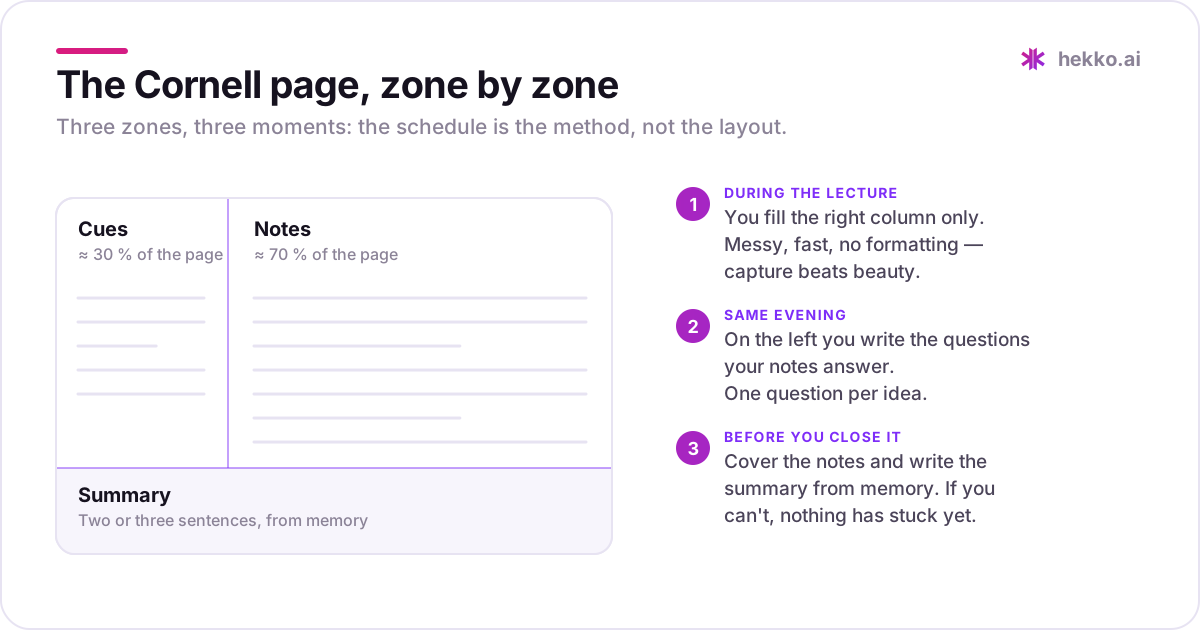
In practice, you take a sheet of paper and divide it into three distinct sections:
1. The right column (notes) This is the largest area, roughly two-thirds of the page. During class, you write your notes here as normal. No need to write down everything word for word. Focus on key ideas, definitions, and important examples.
2. The left column (cues) You fill this narrow column after class. Write down keywords, questions that might come up on an exam, and main concepts. This is your quick-review tool.
3. The summary at the bottom of the page In 2–3 sentences, summarize the key takeaways from the page. This exercise forces you to rephrase in your own words, which anchors the information in your memory.
Why is the Cornell method scientifically effective?
The Cornell method is effective because it forces you to practice active recall and rephrasing — two mechanisms validated by cognitive science research. In a landmark study, Roediger & Karpicke (2006) showed that students who tested themselves retained around 50% more information after one week, compared to those who simply re-read their notes.
Passive re-reading, on the other hand, is one of the least effective methods there is. A meta-analysis by Dunlosky et al. (2013) ranked re-reading and highlighting as "low utility" techniques, while practice testing and spaced revision were rated "high utility." The Cornell method anchors you directly in the practices that work, through two mechanisms:
Active recall. The left column lets you test yourself. You cover the right column, read the question or keyword, and try to retrieve the information from memory. That's far more effective than re-reading — and it's the core of what our guide on how to revise effectively explains.
Rephrasing. Writing a summary at the bottom forces you to process the information deeply. You're not copying anymore, you're understanding. That's exactly what spaced repetition and the Feynman technique share as a founding principle: forcing your brain to actively reconstruct knowledge.
How do you apply the Cornell method step by step?
Take your notes in the right column during class, then that same evening fill in the left column with keywords and questions, and write a summary at the bottom of the page. To revise, cover the right column and test yourself using the cues on the left.
Here is the detailed workflow:
- During class — write in the right column, without worrying about formatting. Short phrases, abbreviations, arrows: anything goes.
- Within 24 hours — fill in the left column with keywords, questions, and essential concepts, while the class is still fresh.
- Write the summary at the bottom of each page in 2–3 sentences. Rephrase in your own words, without looking at the right column.
- To revise — cover the right column, read the left-side cues, and try to reconstruct the lecture from memory. Then check.
- Combine with spaced repetition — review the page at Day+1, Day+3, Day+7, then Day+21 to consolidate durably.
The key is filling in the left column quickly after class. That's what turns your notes into a quiz tool.
What does a Cornell page actually look like?
Here is a worked example drawn from an economics lecture, so you can visualize exactly how to organize your page.
Topic: The Major Economic Crises of the 20th Century
| Left Column — Cues | Right Column — Notes |
|---|---|
| Definition of an economic crisis? | Sudden slowdown in economic activity. Indicators: drop in GDP, rising unemployment, credit contraction. |
| Causes of the 1929 crash? | Household over-indebtedness, stock market speculative bubble, lack of banking regulation. Wall Street collapse, October 1929. |
| Role of the state according to Keynes? | The state must stimulate demand through public spending (counter-cyclical policy). Opposed to the liberal orthodoxy of the time. |
| What policies helped exit the crisis? | The New Deal (Roosevelt): public works, banking reform, social safety nets. Mixed results before WWII. |
Summary (bottom of page):
Economic crises stem from accumulated financial imbalances. Faced with the 1929 crisis, Keynes theorized state intervention as a stabilization tool, inspiring policies like the New Deal. Key takeaway: structural causes + institutional response = the two axes of the lecture.
You see the mechanics: the left column asks questions, the right column answers them. When you revise, you cover the right side and force yourself to answer the left-side questions out loud or in writing — exactly the same principle as making effective revision flashcards.
Cornell vs. linear notes vs. mind maps: which method to choose?
The Cornell method isn't the only option. Here is an honest comparison to help you choose based on your situation.
| Criterion | Cornell Method | Linear Note-Taking | Mind Map |
|---|---|---|---|
| Principle | 3 structured zones (notes / cues / summary) | Continuous top-to-bottom flow | Visual branching around a central concept |
| Main advantage | Integrates active recall and synthesis right at the note-taking stage | Simple and quick to set up | Excellent for visualizing links between concepts |
| Main limitation | Requires a bit of layout discipline | Notes are often passive, hard to use for revision | Difficult to use during a fast-paced dense lecture |
| Ideal for | Lectures, large classes, structured revision | Brainstorming, meetings, quick note-taking | Synthesis revision, chapter diagrams |
| Post-class effort | Medium (filling the left column + summary) | Low | Variable (redrawing the map neatly) |
| Suited to digital | Yes (Notion, Google Docs, dedicated tools) | Yes (everywhere) | Yes (MindMeister, Obsidian, etc.) |
In short: if you want notes that genuinely help you revise, Cornell is the most scientifically robust choice. If you want raw speed, linear notes will do. If you want to map out a chapter at the end of a study block, mind maps are useful as a complement.
Does the Cornell method work for science subjects?
Yes, the Cornell method is just as well suited to science subjects (math, physics, chemistry, biology) as to humanities or social sciences. The cue column can hold formulas to recall, steps in a reasoning process, or the conditions for applying a theorem.
For math and physics, adapt the method slightly:
- Right column: detail the proof or the solution to a worked example, step by step.
- Left column: note the key formula, the conditions of use, and the question the teacher is likely to ask.
- Summary: rephrase the general principle in one sentence (e.g., "Use this formula when looking for velocity as a function of time and initial acceleration").
For subjects with a heavy vocabulary load (law, medicine, languages), the left column becomes an active glossary — you test yourself on exact definitions just like with flashcards, which ties into the findings of Karpicke & Blunt (2011): retrieval practice consistently beats memorization through repetition or classical concept maps.
Should you use the Cornell method on paper or on a computer?
Both work, and the choice depends on your habits and the type of class. On paper, draw a vertical line about 2.5 inches from the left edge and a horizontal line about 2.5 inches from the bottom — you've got your Cornell grid. On a computer, create a two-column table in Notion or Google Docs, with a dedicated text area for the summary.
Arguments for paper:
- Encourages rephrasing — you can't copy-paste, which forces you to process the information.
- Ideal for classes involving diagrams, graphs, or equations.
- Zero distractions.
Arguments for digital:
- Easily accessible and editable from any device.
- Cues can be converted into flashcards or quizzes in seconds.
- You can link your notes to external resources (videos, articles, etc.).
Tools like Hekko go further: they record your in-person or online lecture, transcribe it automatically (the audio is deleted after processing, nothing is stored), then generate structured notes, a revision sheet that condenses the essentials, and on-demand quizzes to train your active recall. You can also import your PDFs, PPTX slides, or Word documents directly. In practice, it's the digital equivalent of the Cornell cue column and summary — automated. For an honest overview of what AI can really bring to your studies, the article on AI and note-taking covers it clearly.
How long does the Cornell method take compared to regular note-taking?
The Cornell method is not more time-consuming than regular note-taking if you build it into a routine — it costs roughly 10 to 15 extra minutes per hour of class to fill in the left column and write the summary.
That post-class time is actually a long-term saving: you avoid having to re-read all your notes in full when an exam approaches. When you come back to your Cornell pages a week later, the left-side cues are enough to trigger recall — you shift into quiz mode rather than reading mode.
To make that time even more worthwhile, combine Cornell with a spaced revision schedule (Day+1, Day+3, Day+7, Day+21). That's the strongest combination for lasting memorization, as we explain in detail in the article on spaced repetition.
How do you integrate the Cornell method into your overall revision routine?
The Cornell method makes most sense when it fits into a coherent revision system. It doesn't replace flashcards, exercises, or past exam papers — it prepares you for them.
Here's how to connect it to your other tools:
- Cornell → Revision sheet: the summaries from each page become the building blocks of your revision sheet. That's a huge time-saver if you make your revision flashcards as you go through the semester rather than the night before.
- Cornell → Quiz / flashcards: the questions in the left column are already your flashcards. Turn them into active recall sessions from Day+1 onward.
- Cornell → Feynman technique: once you've taken your Cornell notes, try explaining the lecture out loud without looking at the right column. That's exactly the principle of the Feynman technique.
- Cornell + Spaced repetition: schedule your test sessions at increasing intervals to consolidate information over the long term.
The Cornell method doesn't ask you to overhaul your habits completely. It just asks you to add 15 minutes of active processing after each class — and it's that quarter-hour that makes all the difference between forgotten notes and a lecture you've truly mastered.
Ready to save time on your notes?
Hekko transcribes your lectures and generates notes automatically. Try it for free.
Get started for free