How to Revise With Flashcards (and Actually Remember)
You flip a card, see the answer, and think "yes, I knew that". Three days later, it's gone. The problem is almost never your memory: it's the card itself, and the way you use it. A badly written flashcard gives you the feeling of knowing without ever making you work. A well-written one is the most cost-effective revision tool there is, because it forces you to produce the information instead of recognising it.
Here's how to write cards that earn their place, how to revise with them day to day, and what to do with the ones that never stick.
What is a flashcard, and why does it work?
A flashcard has two sides: a question on the front, an answer on the back. Nothing more. Its power doesn't come from the format, but from what the format forces on you: before flipping the card, you have to produce the answer yourself.
This is active recall. The gap with re-reading is substantial, and it has been documented for a long time. Roediger and Karpicke (2006) showed that students who tested themselves on a text remembered it far better a week later than those who had re-read it several times — even though the re-readers felt more confident. The meta-analysis by Dunlosky et al. (2013) ranks practice testing among the few techniques with "high utility", while highlighting and re-reading are rated low utility.
The effort matters as much as the outcome. Searching for an answer for a few seconds, even without finding it, consolidates the memory trace more than an instant answer does. It's counter-intuitive: the session where you struggle is the one that makes you progress.
Second pillar: spacing. A card reviewed at the right moment, just before you forget it, is worth ten readings in a row. The mechanism and the intervals are covered in our article on spaced repetition — it's the essential complement to what follows. Just hold on to the principle: flashcards are the tool, spacing is the schedule.
How do you write a good flashcard?
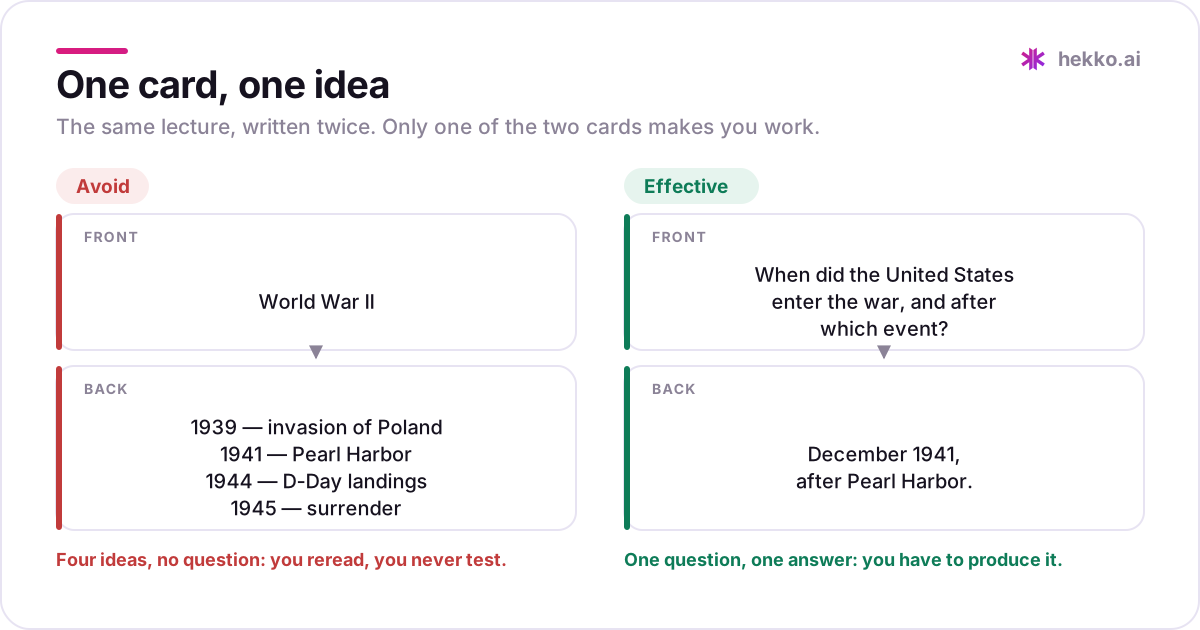
The rule that contains all the others: one card, one idea. If your answer holds two pieces of information, you need two cards.
A card asking "Explain the French Revolution" isn't a flashcard, it's an essay question. You'll never be able to grade yourself honestly on it. Break it down:
| Card that's too broad | Usable cards |
|---|---|
| "Explain the French Revolution" | "In what year was the Bastille stormed?" |
| "Which event of 1789 abolished privileges?" | |
| "Who drafted the Declaration of the Rights of Man?" |
Three concrete principles:
Ask a real question. A single word on the front ("Photosynthesis") doesn't tell you what's expected: the definition? the equation? the conditions? Write "What is the overall equation for photosynthesis?". You'll know exactly what to produce.
Make the answer checkable. You must be able to say "right" or "wrong" without hesitating. A vague answer makes self-assessment impossible, and impossible self-assessment makes the card useless.
Write it in your own words. Copying your lecturer's sentence is the most common reflex and the most expensive one: you memorise a phrasing, not an idea. Rephrasing forces you to understand before memorising — exactly the principle behind the Feynman technique.
For science subjects, a card can ask for a procedure rather than a fact: "What's the first step in solving a quadratic equation?". You're testing the method, not just the result.
Which mistakes make your flashcards useless?
Four mistakes come up again and again, and they all produce the same symptom: you ace your cards and fail your exam.
Confusing recognising with retrieving. If the answer is visible out of the corner of your eye, or if the cards always come in the same order, you're recognising a pattern instead of retrieving information. Shuffle your cards every session, and cover the back completely.
Writing cards that give it away. A question that already contains half the answer ("What is Newton's law of inertia?") tests nothing. Flip it around: "What does Newton's first law state?".
Making cards before you've understood. A flashcard memorises, it doesn't explain. If you don't understand the lecture, you'll memorise a hollow sentence you won't know how to reuse in a problem. Understand first, build the cards second.
Turning everything into cards. A whole chapter cut into 200 cards becomes filing work, not revision. Flashcards serve what has to be known cold: definitions, dates, formulas, vocabulary, mechanisms. The rest — reasoning, argument — is revised differently.
How do you revise with your flashcards day to day?
The loop is four moves, and it never changes:
- Read the front and close your eyes. Say the answer out loud or in your head, in full. Don't flip until you've tried.
- Give yourself a few seconds. The retrieval effort is the moment memory does its work. Flipping after one second isn't revising, it's reading.
- Flip it and mark yourself harshly. "More or less" means wrong. On exam day, "more or less" scores nothing.
- Sort. Right: you'll see it again later. Wrong: it comes back in today's session, and sooner than the rest.
Three habits that make the difference:
- Short, frequent sessions. Fifteen minutes a day beats two hours on Sunday, because spacing does the work for you.
- Out loud when you can. Saying it forces a complete answer; in your head, you quickly settle for "yes, that's it".
- Both directions, where it makes sense. For vocabulary or definitions, test front → back then back → front. Knowing how to translate "ubiquitous" isn't the same as knowing how to produce it.
What do you do with the cards you always get wrong?
Every deck ends up with three or four cards that resist everything. Repeating them more doesn't help: the problem is in the card, not in your memory.
Three reflexes, in this order:
Split it. A card you miss on a loop almost always hides several pieces of information. Two simple cards beat one impossible card.
Add a hook. An example, a mental image, a counter-example, the origin of a word. An isolated fact fades; a fact attached to something you already know holds.
Check that you've understood. If you can't explain the answer to someone in two sentences, you're trying to memorise something you don't understand. Go back to the lecture, then rewrite the card.
Flashcards or revision sheets: which should you choose?
These are two different tools, often confused because they serve the same time of year.
| Flashcards | Revision sheet | |
|---|---|---|
| Format | Question / answer card | One page summarising a chapter |
| What it trains | Retrieving one precise fact | Seeing the overall structure |
| Use | Short, repeated sessions | Reading before the exam |
| Best for | Definitions, dates, formulas, vocabulary | Outlines, sequences, the big picture |
The sheet gives you the map of the territory, the flashcards make you walk through it. Use the sheet to grasp how a chapter is organised, the cards to lock in what has to be instantly available on the day. Our guide on revision sheets covers the summarising side.
How many cards per chapter, and when should you make them?
Count on 15 to 30 cards for a typical chapter. Below that, you're missing the essentials; above it, you've probably converted your lecture into cards instead of selecting from it.
The best moment to make them is the day of the lecture, or the next day at the latest. Two reasons: the lecture is still fresh, so you write fast and accurately; and you can run your first recall session within 24 hours, when forgetting is at its steepest.
Making your cards the night before the exam is the worst case: building them eats the time that should go to revising, and leaves no room at all for spacing. If that's where you are, our article on revising the night before an exam sets out what to do.
Paper, Anki or an app: which support should you pick?
| Support | Strengths | Limits |
|---|---|---|
| Paper | Zero friction, writing aids memory | Manual sorting, awkward to carry in bulk |
| Anki | Intervals calculated automatically, free | Slow card creation, austere learning curve |
| Hekko | Cards generated from your lecture, scheduled review | You should read the generated cards before trusting them |
Paper is still excellent if you have few cards and like writing. Anki is the reference for a fully automated interval system, provided you accept the time it takes to build the cards.
The real friction point, whatever the tool, is the same for everyone: making the cards takes longer than reviewing them. That's the number one reason flashcard decks are abandoned by November.
Looking beyond flashcards? Our comparison of the best AI note-taking apps for students sets out each app's free tier, real price and limits.
Can you generate your flashcards automatically?
Yes, and that's exactly the problem Hekko solves.
You record your lecture, or import your documents (PDF, Word, PowerPoint, images). Hekko turns them into structured notes, a revision sheet, quizzes — and front/back flashcards generated straight from your lecture, without writing a single card by hand. You flip, you mark yourself, and you redo the ones you miss.
The revision mode handles the calendar: Hekko places each review just before you forget and tells you what to go over today. No intervals to calculate, no schedule to keep — which is precisely the part everyone abandons after three weeks.
One piece of advice that applies to any generator, this one included: read your cards before trusting them. A generated card is still a card to validate, and a card you rephrase in your own words will always take you further.
Flashcards aren't a shortcut for students in a hurry. They're the most direct translation of two mechanisms research has firmly established: you remember what you retrieve, and you remember what you retrieve at the right moment. The rest is a matter of consistency — and of well-written cards.
Try Hekko on your next lecture: you get your notes, your revision sheet and your flashcards in minutes, and all that's left is to revise.
Ready to save time on your notes?
Hekko transcribes your lectures and generates notes automatically. Try it for free.
Get started for free