How to Make Good Revision Flashcards (That Actually Work)
You spent an entire evening making beautiful color-coded flashcards… and never really used them again. The problem isn't your motivation: it's the way most flashcards are designed. A good flashcard isn't a summary — it's a training tool.
How do you make good revision flashcards?
A good flashcard turns your lecture into questions, not a summary to re-read. Write a question, keyword, or problem on one side and the answer on the other, so you can test yourself instead of re-reading. Keep it concise: one idea per card, keywords rather than full sentences, and your own words.
The ingredients of an effective flashcard:
- A clear question or trigger (not just a heading)
- A concise answer you should be able to produce from memory
- Your own phrasing, not copied and pasted from the lecture
- One single concept per card so you can shuffle and test them in any order
This principle — testing yourself rather than re-reading — is at the heart of what separates a useful flashcard from a decorative one. Keep it in mind for everything that follows.
What is the most common mistake with flashcards?
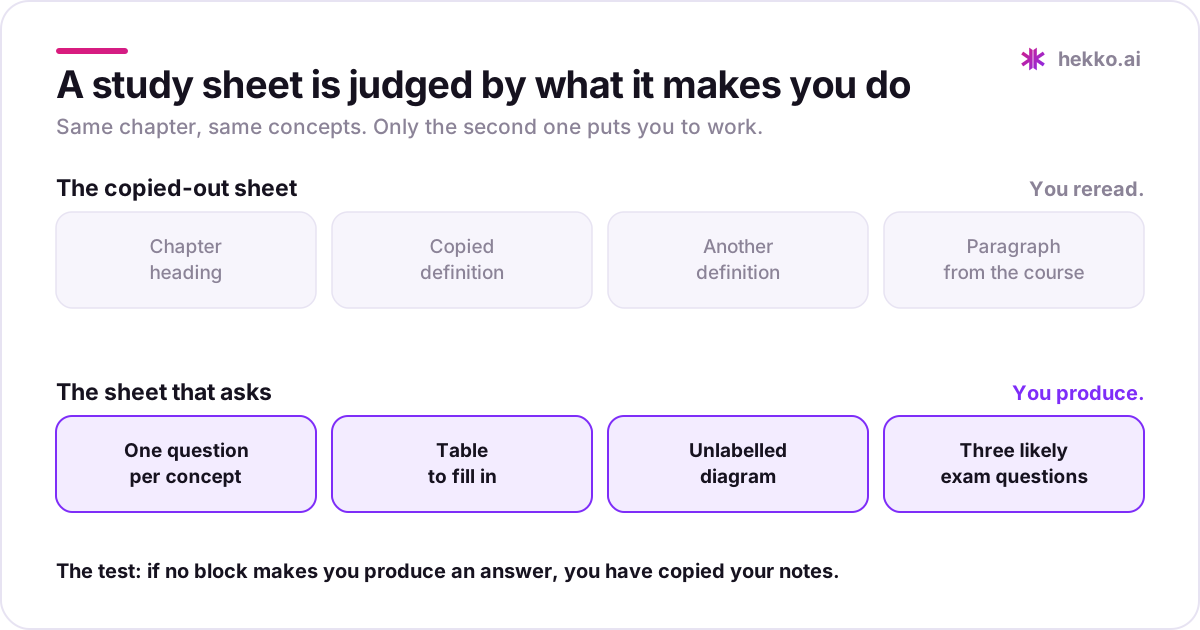
Copying the lecture out in condensed form. That's mistake number one, and it's tricky because it feels like working. But copying remains a passive activity: the synthesis by Dunlosky et al. (2013) ranks this type of re-reading among low-utility methods, far behind knowledge testing.
A flashcard you only re-read triggers no memory effort. A flashcard that asks you a question forces you to produce the answer — and it's that effort that creates learning. Cognitive science calls this the testing effect: the simple act of recalling information consolidates it far more effectively than reading it again.
Bad flashcard vs. good flashcard: a concrete example?
Here is the same lecture content presented two ways. The topic: the definition of bodily injury in civil liability law.
Bad flashcard (copied summary):
Bodily injury — Harm to a person's physical or psychological integrity. May include financial losses (lost income, medical expenses) and non-financial losses (pain, aesthetic harm, loss of a chance). Distinguish between harm and damage.
You re-read it, you tell yourself "yeah, I know that" — and a week later you freeze up in the exam.
Good flashcard (question / answer):
Front: What are the two broad categories of losses in a bodily injury claim?
Back: Financial losses (lost income, medical expenses) and non-financial losses (pain, aesthetic harm, loss of a chance). ≠ harm (the fact) vs. damage (the consequence).
The difference? The second one forces you to produce the answer before flipping the card. It's that retrieval effort that engraves the information in memory — Roediger & Karpicke (2006) showed that testing yourself produces significantly higher retention than re-reading alone after a week.
The same principle works in biology, economics, literature: always phrase the front as a real question, not a heading.
What types of flashcards exist and which should you choose?
There's no universal format. Here are the three most common approaches, their strengths, and their limitations:
| Type of flashcard | Ideal use | Main limitation |
|---|---|---|
| Flashcard (front/back) | Definitions, formulas, vocabulary, key dates | Isolates concepts, may not train overall logic well |
| Summary sheet | Overview of a chapter, mapping links between concepts | Easy to re-read passively without active effort |
| Question-answer card | Exam-oriented revision, open questions or sample problems | Takes more time to create, but the most effective |
In practice, the two most useful formats are the flashcard for isolated factual elements and the question-answer card for concepts that require reasoning. The summary sheet is useful at the start of revision to remind yourself of the chapter structure, but don't use it as your main memorization tool — the risk of passive re-reading is too high.
When should you make your revision flashcards?
Throughout the semester, not the night before the exam. Make your flashcard within 24 hours of the lecture, while the content is still fresh: you make it faster and consolidate at the same time. You can then review it on a spaced repetition schedule until the exam.
Cepeda et al. (2006) demonstrated that revisions spread over time produce durably superior memorization compared to sessions massed right before the exam. In other words: reviewing your flashcard three times over three weeks is far better than reviewing it three times on the same evening.
Making flashcards the night before means stacking two major efforts at the worst possible moment: creating the material and learning it simultaneously, under stress. Avoid it — see instead how to revise the night before an exam when time is short.
Paper or digital flashcards: which to choose?
The medium matters less than the method, but each format has practical advantages. Paper flashcards encourage concentration (no distractions) and the act of writing by hand, which reinforces encoding. Digital flashcards allow synchronization across devices, automated spaced repetition, and revision on the go.
A few benchmarks to help you choose:
- You study better without a screen and have the time? → paper, preferably index cards.
- You want to plan your revision automatically and study anywhere? → digital, with a tool that manages spaced repetition.
- You're short on time and mainly want to focus on the content? → digital, taking advantage of tools that generate a first version of the flashcard from your lecture.
Both formats are compatible: some students create their flashcards on screen and print them out for the final revision.
How many flashcards should you make per chapter?
There's no magic number, but a practical rule: one flashcard = one testable concept, not a whole chapter. A 10-page chapter typically produces between 10 and 25 flashcards depending on content density.
If you find yourself making 50 for a single chapter, you're segmenting too finely — group the secondary details together. If you have 3, you're working too superficially. The right sign: when you flip each card, you should have a precise answer to give, neither too vague nor too long.
A useful technique: after creating your flashcards, do an immediate first test. All the ones you answer without hesitation don't need to be reviewed as frequently. Focus on the ones that stump you.
How do you revise with your flashcards effectively?
Having good flashcards is useless if you just re-read them. The protocol that works:
- Cover the answer (flip the card, hide the back on a digital card).
- State your answer out loud or in writing before looking.
- Evaluate honestly: you knew it, you hesitated, you didn't know.
- Put back in the "to review" pile the cards you got wrong or hesitated on.
- Spaced over time: restart the session 2–3 days later, not the same evening.
This protocol is exactly what spaced repetition automates — see how to revise effectively for integrating this into a complete schedule.
Are Anki or Quizlet flashcards effective?
Yes, if you use them the right way. Anki and Quizlet implement spaced repetition, which is scientifically sound. But effectiveness depends on the quality of your flashcards.
The Anki/Quizlet trap: downloading someone else's deck. You don't make the content your own, you train on phrasings that aren't yours — and you don't necessarily understand why the answer is what it is. The ideal is to create your own flashcards (or seriously rework any you import), then use the spaced repetition algorithm to schedule your sessions.
Another trap: accumulating hundreds of flashcards without ever pruning. A card you've mastered perfectly for weeks is taking up revision time that would be better used elsewhere. Regularly sort through them.
Can you generate revision flashcards with AI?
Yes, and it's a real time-saver if you use them actively. From your lecture, tools like Hekko record a class or import your documents (PDFs, images, PPTX, Word), then automatically generate a structured revision sheet — the essentials, key definitions, concepts to master, and likely exam questions — as well as a quiz to test yourself on them.
The audio from your recordings is not kept: only the transcription is processed to generate the outputs.
AI saves you the mechanical part — formatting and extracting key points from a dense lecture — but it doesn't revise for you. The work that pays off remains the same: testing yourself from memory on these flashcards, again and again, rather than passively re-reading them. The generated sheet is a starting point, not an end in itself: you can annotate it, add to it, and use it as a base to create your own question-answer flashcards.
For more on active learning methods, also check out the Feynman technique — explaining a concept in your own words is one of the most effective ways to verify you've truly understood it.
Ready to save time on your notes?
Hekko transcribes your lectures and generates notes automatically. Try it for free.
Get started for free