How to Revise Effectively the Night Before an Exam
You have 24 hours left before the exam and you haven't revised everything. Don't panic: the night before isn't about learning everything from scratch, it's about consolidating and targeting. This is not the moment to discover a new chapter — it's the moment to secure what you already half-know and fill a few precise gaps. Here's how to make the most of these last hours.
Can you really revise effectively the night before an exam?
Yes, as long as you don't try to learn everything from zero. The night before is for consolidating what you already half-know and filling a few targeted gaps — not for ingesting an entire semester. If you've done at least some work beforehand, a well-organized day before the exam can make a real difference to your final grade.
The most frequent mistake is treating the night before as an intensive learning session. In neuroscience, we distinguish encoding (learning something new, which requires time and repetition) and consolidation (anchoring what's already been encoded). The night before, you're in consolidation mode. That implies different methods: less passive reading, more active recall, self-testing, and verbalizing.
If you're genuinely discovering the material for the first time the day before, change your goal: aim for understanding the big ideas and central mechanisms rather than exhaustiveness. A well-understood course outline is worth more than ten skimmed pages you won't retain.
How many hours should you revise the night before an exam?
The ideal duration is four to six hours of effective work, spread over the day with regular breaks. Beyond six hours, returns drop sharply: cognitive fatigue means you're reading without retaining, your stress increases, and you eat into your sleep — which is precisely when your brain consolidates what you've learned.
Quality always trumps quantity. Six concentrated hours, with short work sessions interspersed with breaks, are far more effective than ten hours of scattered attention in front of your notes. Research on memory and learning consistently shows that breaks are not wasted time: they allow your brain to process and organize information.
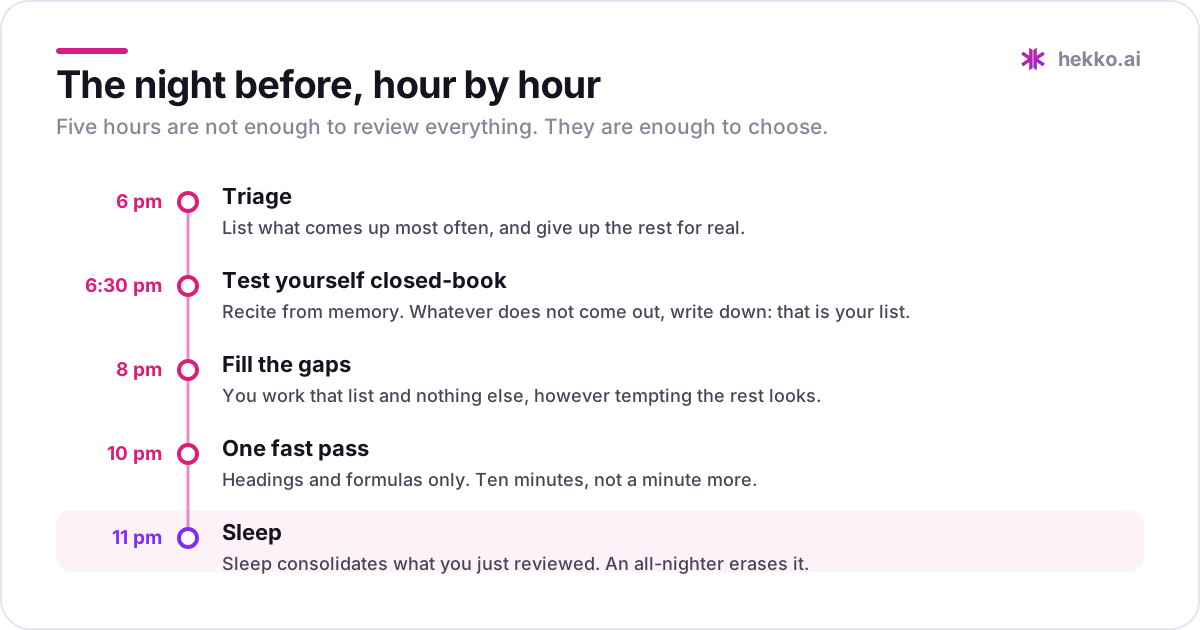
To structure your day, here's an hour-by-hour schedule you can adapt based on your exam time:
| Time | Activity | Duration |
|---|---|---|
| 8:00 am | Wake up, calm breakfast (no revision immediately) | 30 min |
| 8:30 am | Prioritization: list your topics, categorize as mastered / shaky / not covered | 20 min |
| 8:50 am | Block 1 — Priority shaky topics (active recall, mini-quiz) | 50 min |
| 9:40 am | Active break (short walk, stretching) | 15 min |
| 9:55 am | Block 2 — Second shaky topic or review of key definitions | 50 min |
| 10:45 am | Break, light snack | 15 min |
| 11:00 am | Block 3 — Topics you know well: quick confirmation review | 40 min |
| 11:40 am | Lunch break with no revision (eat, disconnect) | 60 min |
| 12:40 pm | Block 4 — Revision sheet: active reading + verbal rephrasing | 50 min |
| 1:30 pm | Break | 15 min |
| 1:45 pm | Block 5 — Final self-assessment (quiz or sample exam questions) | 45 min |
| 2:30 pm | Stop revision. Practical preparation (bag, travel, etc.) | 30 min |
| Evening | Relaxing activity, dinner, preparing for sleep | — |
| 10:30–11:00 pm | Bed. Sleep at least 7–8 hours. | — |
This schedule assumes a morning exam the next day. If your exam is in the afternoon, shift everything by one or two hours and use the morning of the exam for a short review (see below).
What should you prioritize revising the night before?
Focus on high-yield concepts: those that come up frequently, that structure the whole course, or that carry the most points. Leave aside anecdotal details. It's better to solidly master 70 to 80% of the syllabus than to skim 100% without retaining anything.
The three-category prioritization method is remarkably effective:
- Mastered — you can explain it from memory without hesitation. Spend 10 minutes max confirming, no more.
- Shaky — you have a general idea but stumble on details or phrasing. This is where you spend most of your time: these points are the most profitable because a targeted effort is enough to move them into the "mastered" column.
- Not covered — you haven't worked on this chapter at all. Unless it represents a massive portion of the exam, leave it aside and focus on what's already been started.
For each shaky topic, prioritize active recall: close your notes, try to write or say from memory what you know, then check. Research shows that testing yourself on material produces far better retention than simply re-reading or highlighting (Dunlosky et al., 2013; Roediger & Karpicke, 2006). Testing yourself can lead to around 50% more retention after a week compared to passive re-reading. In other words, two hours spent testing yourself is worth far more than two hours spent re-reading.
If you've been building a revision sheet or quizzes throughout the semester — for example after each class with Hekko — the night before becomes a structured recall session rather than a panic sprint. The sheets and questions drawn from your own lectures are exactly the right tool for these last hours.
Should you stay up all night before an exam?
No. Pulling an all-nighter is counterproductive, and this is one of the rare points on which cognitive science research is unanimous. Sleep plays a direct role in memory consolidation: it's while you sleep that your brain transfers what you learned during the day into long-term memory (Diekelmann & Born, 2010).
Concretely, this consolidation process cannot be replaced by more revision. You can spend two extra hours on your notes at 2 am, but your tired brain will record little that's new and will lose some of what it had already consolidated. On exam day, you'll be less focused, slower, more anxious, and less able to mobilize your knowledge under pressure.
Simple rule: go to bed at your usual time, or slightly earlier. Aim for seven to eight hours. If you have trouble falling asleep because of stress, that's normal — an hour less won't fundamentally change your performance. What would be catastrophic is sleeping only three or four hours.
Avoid screens in the thirty minutes before bed. Read something light, listen to calm music, or do breathing exercises. Don't check social media to see how others are "pulling through" all night — that's a false good idea that reinforces bad practices.
How do you manage stress the night before an exam?
Moderate stress is normal and even useful: it signals that the stakes are real and helps you stay focused. It's excessive stress that's harmful — the kind that paralyzes, sends negative thoughts in circles, and degrades short-term memory.
A few concrete strategies:
- Stop revising at a fixed time, whether you feel "ready" or not. The feeling of never having done enough is normal and doesn't reflect your actual level.
- Limit contact with other anxious people. A corridor conversation with panicking classmates can destabilize you in minutes. Protect your mental state.
- Do a short physical activity in the late afternoon — even twenty minutes of walking. Exercise reduces stress hormones and improves sleep quality.
- Write down your worries. If anxious thoughts are intruding while you revise, jot them down on a separate sheet. This simple act "unloads" your brain and frees up mental space to concentrate.
- Prepare everything the night before: pens, student ID, exam admission ticket, calculator if needed. Knowing everything is ready reduces anticipatory anxiety.
Stress is largely fueled by a sense of loss of control. Having a clear plan, knowing what you're revising and when you're stopping, puts you back in control. That's precisely what a structured method provides, rather than panic-mode revision.
For more on memorization methods that reduce stress over the long term, see our article on spaced repetition.
What should you eat before an exam?
Your diet directly influences your concentration and energy levels. A few simple principles, without going into medical recommendations:
- The night before: a complete, balanced meal, without excess. Avoid very heavy meals that disrupt sleep. No alcohol — even "to relax," alcohol fragments sleep and undermines memory consolidation.
- On the morning of the exam: eat a proper breakfast, even if you're not hungry. Your brain consumes glucose to function, and heading into a two-hour exam on an empty stomach is a bad idea. Prefer slow-digesting foods (eggs, whole-grain bread, yogurt, fruit) over fast sugars that cause an energy crash mid-morning.
- Hydration: drink enough water throughout the day. Even mild dehydration affects concentration and memory. If you're allowed a water bottle during the exam, bring one.
- Coffee: in moderation. One cup in the morning can help you be alert, but too much caffeine increases anxiety and can cause shaking or difficulty concentrating. Avoid overdoing it if you're not used to it.
Should you revise on the morning of the exam?
Yes, but briefly and differently. The morning of the exam isn't a regular revision session — it's activation. Your goal is to put your knowledge into accessible mode, not to acquire new material.
Spend twenty to thirty minutes maximum reviewing your main revision sheet, recalling the broad structures of the course, and mentally running through the key points. You can redo two or three questions from memory to "warm up" your brain. Then stop.
What to absolutely avoid in the morning:
- Discovering a new point and panicking because you don't know it
- Revising with anxious classmates in the hallway
- Comparing yourself to those who have "revised everything" (nobody actually has)
- Arriving late in a rush — allow a margin of twenty to thirty minutes
Arriving early, settling in calmly, reading the instructions carefully before starting to write: these are simple habits that have a real impact on your performance.
How do you prepare for future exams so the night before is never a crisis?
A stressful night before is often the consequence of insufficient preparation beforehand. The structural solution is to integrate revision into your daily routine rather than postponing everything to the last week.
The methods that work over time: spaced repetition for progressive memorization, active recall after each class, and summary sheets drafted throughout the semester. If you take notes during class — or have them transcribed automatically — transforming them into a revision sheet right after class takes ten minutes and saves you several hours during exam season.
Hekko lets you record your lectures, have them transcribed automatically (the audio is deleted, nothing is stored), then generate structured notes, a revision sheet, and an on-demand quiz. You can also import your PDFs, presentations, and Word documents to integrate them into the same flow. The result: instead of arriving the night before your exam with a raw, undeciphered course, you arrive with a sheet already built and questions you've already faced.
For more on organizing your revision overall, see our guide on how to revise effectively.
Ready to save time on your notes?
Hekko transcribes your lectures and generates notes automatically. Try it for free.
Get started for free