Can AI Really Take Notes for You?
Everyone's talking about AI. But when it comes to taking lecture notes, can artificial intelligence actually help — or is it just marketing? The answer is nuanced: AI does some things remarkably well, and others frankly poorly. Here's an honest assessment, no spin.
How does AI applied to note-taking work?
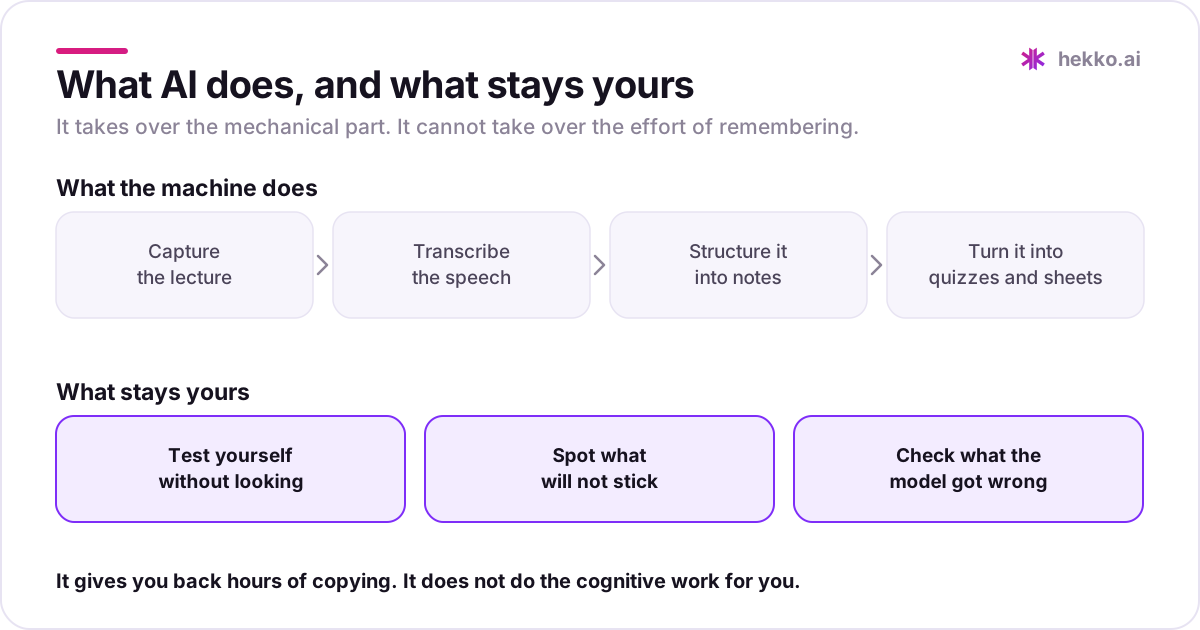
AI for note-taking rests on two components: automatic speech recognition (ASR) and structured text generation (LLM). The microphone captures the audio from your lecture, a speech recognition model converts it into raw text, then a large language model reorganizes that text into readable notes. This pipeline — audio → transcription → structuring — now works in a matter of minutes, whereas manual note-taking used to take you all evening.
This is a break from older tools, which only recorded or transcribed without structuring anything. What really changes is the layer of comprehension added by the LLM.
Can AI transcribe a lecture accurately?
Yes — this is the undisputed strong point. In good conditions (decent microphone, limited background noise), current models achieve accuracy in the region of 95%. They handle accents, fast speech, and even a large portion of subject-specific vocabulary. You record your two-hour lecture and recover a written text of almost everything that was said.
The limitations are real, though. A professor who mumbles, a lecture hall with poor acoustics, or a chair scraping the floor during the two best minutes of the class — all of this degrades quality. In a biochemistry lecture with ten Latin terms per minute, the transcription will be correct on sentence structure but may miss a specific technical word. Always plan to re-read the transcription once after class to correct the few remaining errors.
Concrete case — noisy law lecture. Two students chatting in the background, the professor speaking fast with a regional accent. Typical result: 92–93% accuracy, around ten errors in an hour of class, often on proper nouns (case law, authors). A quick pass is enough to correct them; the essentials are immediately usable.
Can AI structure usable lecture notes?
Yes. From a raw transcription, an LLM identifies the hierarchy of ideas, groups information by theme, and produces notes in structured prose with headings, subheadings, key points, and highlighted definitions. The result looks like lecture notes written by someone who knows the pedagogical format.
It's not perfect. AI can include a professor's digressions, miss a logical transition, or over-summarize a point that was developed at length. But the time saving is real: where you used to spend 90 minutes cleaning up a 2-hour lecture, you now spend 15 minutes reviewing and annotating the generated notes. That freed-up time is what you reinvest in understanding.
Can AI generate revision sheets and quizzes?
Yes — and this is where AI genuinely adds value to your revision. From your notes or the transcription, it extracts key concepts, definitions to remember, likely exam questions, and offers a quiz to test yourself.
The quiz is not a gimmick. Roediger & Karpicke (2006) showed that testing yourself on material can increase retention by around 50% after a week, compared to passive re-reading. Dunlosky et al. (2013) confirm that practice testing and spaced repetition are the two most effective study techniques. AI doesn't make you learn all by itself — but it generates in seconds the raw material (quiz, revision sheet) that you wouldn't have created out of laziness or lack of time.
For more on how to use these revision tools intelligently, the article on how to revise effectively details the research-validated techniques.
Can AI generate notes from slides or PDFs?
Yes — and this is a feature that is often underestimated. In addition to recording live lectures, Hekko lets you import PDFs, slide images, PPTX presentations, or Word files. The AI extracts the content from these documents and generates the same outputs: structured notes, a revision sheet, a quiz.
Typical use case: your professor posts their slides on the learning platform the night before the lecture. You import them, Hekko produces a pre-lecture revision sheet. You arrive in class with a solid base of understanding, you take audio notes during the lecture, and you merge everything afterward. That's a significant preparation gain, especially for dense theoretical courses.
Another case: you receive an academic article in PDF format or a classmate's notes in Word. Import them directly — no need to copy everything out by hand.
Can you trust AI-generated notes?
Partially — and that's the right attitude. AI-generated notes are a reliable starting point, not an absolute source of truth. Several risks exist:
- Hallucination: an LLM can rephrase a concept in a subtly incorrect way, especially with technical notions or precise formulas.
- Over-simplification: AI may summarize a complex argument while losing a nuance that is decisive for understanding the logic.
- Omission: if the professor said something important between two digressions, AI may deprioritize it.
The golden rule: treat generated notes the way you'd treat notes from an intelligent classmate — useful, worth re-reading, to be validated on sensitive points. Keep the reflex of cross-checking any notion you don't understand against the original lecture or a reference source.
| What AI does well | What AI doesn't do (yet) |
|---|---|
| Transcribe audio accurately (~95% in good conditions) | Understand whether you've already absorbed a concept or not |
| Hierarchically structure a dense lecture | Replace your effort of deep understanding |
| Extract key definitions and concepts | Filter what will really be on the exam from your specific professor |
| Generate a revision sheet in seconds | Guarantee the accuracy of every technical rephrasing |
| Create a quiz for active recall | Substitute for spaced repetition over time |
| Process imported PDFs, PPTX slides, and Word files | Interpret an illustration, graph, or complex equation |
Will AI replace manual note-taking?
Probably not entirely — and that's not necessarily a bad thing. Taking notes by hand (or actively typing) forces you to process information in real time: you have to decide what's important, rephrase in your own words. That cognitive process has value in itself.
AI changes the equation, but doesn't cancel it. The right model is complementarity: AI handles the transcription and mechanical formatting, while you stay active during class (listening, asking yourself questions, jotting brief annotations) and active afterward (reviewing, understanding, revising).
What disappears in this model is the tedious transcription and the creation of revision sheets from scratch. What remains — and this is the essential part — is the real intellectual work. If you want to explore how to balance manual note-taking and digital tools, the article on taking notes in lectures gives concrete benchmarks.
Can AI replace active revision?
No — that's the most important limitation to keep in mind. Having perfectly structured notes is useless if you just read them passively. Dunlosky et al. (2013) show this clearly: re-reading and highlighting have low cognitive utility. What works is practice testing and spaced repetition.
AI can generate the quiz, create the revision sheet, organize the material to revise — but you have to answer the questions, close your notes, and actively recall the concepts. It makes the right tools accessible; it cannot do the cognitive effort for you. To understand why spaced repetition is so effective, the dedicated article on spaced repetition explains the mechanics in detail.
What's the right workflow for using AI intelligently?
AI is a tool, not a miracle solution. Here's the workflow that works:
- Before class (if slides are available): import the documents into Hekko to have a base of understanding before arriving at the lecture.
- During class: record and stay active — listen, ask yourself mental questions, note the moments where you lose track.
- Right after class: retrieve the transcription and generated notes; correct any errors (5–10 minutes).
- That evening: re-read the notes, identify what you don't understand, annotate with your own words.
- When revising: use the revision sheet and quizzes as the basis for active recall — close your notes, answer, check, redo the ones you missed.
The time saved on transcription and formatting — easily 1 to 2 hours per class — you reinvest in the high-value steps: understanding, testing, spacing your revision. That's where AI truly changes the game.
AI isn't going to sit your exams for you. But used correctly, it can save you hours each week on the mechanical part, so you can focus on what really matters: understanding, retaining, and succeeding. If you want to see concretely how to integrate all of this into your overall revision method, the article on making revision flashcards is a great complement to this overview.
That leaves the practical question: which one? These apps do not all do the same job — some transcribe, some summarise, few do both well. Our roundup of the best AI note-taking apps for students compares them on exactly that.
Ready to save time on your notes?
Hekko transcribes your lectures and generates notes automatically. Try it for free.
Get started for free